Choosing the right electrical cable is one of the most important decisions in any project—whether you’re wiring a home, installing machinery, or supplying power across industrial sites. The correct cable affects safety, efficiency, lifespan, and compliance, while the wrong choice can lead to overheating, voltage drop, equipment failure, or even fire hazards.
Because electrical standards vary across global markets—IEC in Southeast Asia, GB in China, AS/NZS in Australia, and NEC in the United States—buyers often face confusing cable names, different temperature ratings, and inconsistent material requirements. A cable that works in one country may not be accepted in another.
This guide provides a universal selection framework to help global buyers choose the right electrical cable based on environment, material, certification, voltage, and mechanical protection requirements—regardless of region.
Table of Contents
Selection Factor 1: Standards & Certification
Global Wiring Standards & Voltage Requirements (Quick Comparison)
| Region / Market | Main Standard | Typical Voltage System | What It Means for Cable Selection |
|---|---|---|---|
| United States | NEC (National Electrical Code) | 120/240V | Requires UL-listed cables (THHN, NM-B). PVC often used; follow strict flame tests. |
| Australia / New Zealand | AS/NZS 3000 + AS/NZS 5000 | 230/240V | Use V75/V90, TPS, XLPE types. Mandatory temperature + UV requirements. |
| China | GB / GB/T + CCC Certification | 220/380V | Use BV/BYJ/YJV/YJV22. Many cables exceed IEC. CCC required for building wires. |
| Thailand | TIS (Thai Industrial Standard) | 220/230V | NYY, NYM widely used. Must comply with TIS manufacturing specs. |
| Southeast Asia (Malaysia, Indonesia, etc.) | IEC-aligned standards (SIRIM, SPLN) | 220/230V | IEC-style cables (NYM, H07RN-F, XLPE). Certification varies by country. |
Always match your cable choice to the local wiring standard (NEC, AS/NZS, GB, TIS) and ensure the voltage rating meets the region’s electrical system requirements.
Selection Factor 2: Environment
Choosing the right cable also depends heavily on the installation environment. Different conditions demand different insulation materials, jackets, and protection levels to ensure long-term safety and performance.
Environment Overview & Recommended Cable Types
| Environment Condition | Key Risks | Recommended Cable Types | Reasons |
|---|---|---|---|
| Indoor (dry areas) | Minimal moisture | BV, H05VV-F | PVC cables are economical and adequate for indoor protection. |
| Outdoor (sun exposure) | UV damage, heat | H07RN-F, XLPE cables, V90 | UV-resistant rubber or XLPE maintains performance under sunlight and higher temperatures. |
| High humidity / tropical climate | Moisture ingress, corrosion | NYM, H07RN-F, LSHF XLPE | Extra jacket thickness and moisture-resistant insulation prevent degradation. |
| Underground installation | Soil pressure, moisture | YJV22, NYY, XLPE armoured cables | Armouring and PE sheath provide mechanical and water protection. |
| Industrial / machinery | Oil, abrasion, vibration | H07RN-F, SY/Control cables | Flexible rubber cables handle movement and mechanical stress. |
To summarize, match cable insulation and sheathing to real-world conditions, for example, wet areas need moisture-resistant PVC/XLPE, while outdoor areas need UV-resistant materials, and underground routes require armouring.
Selection Factor 3: Materials
Cable materials decide how safely, efficiently, and reliably your system performs—here’s a quick visual guide to the core differences.
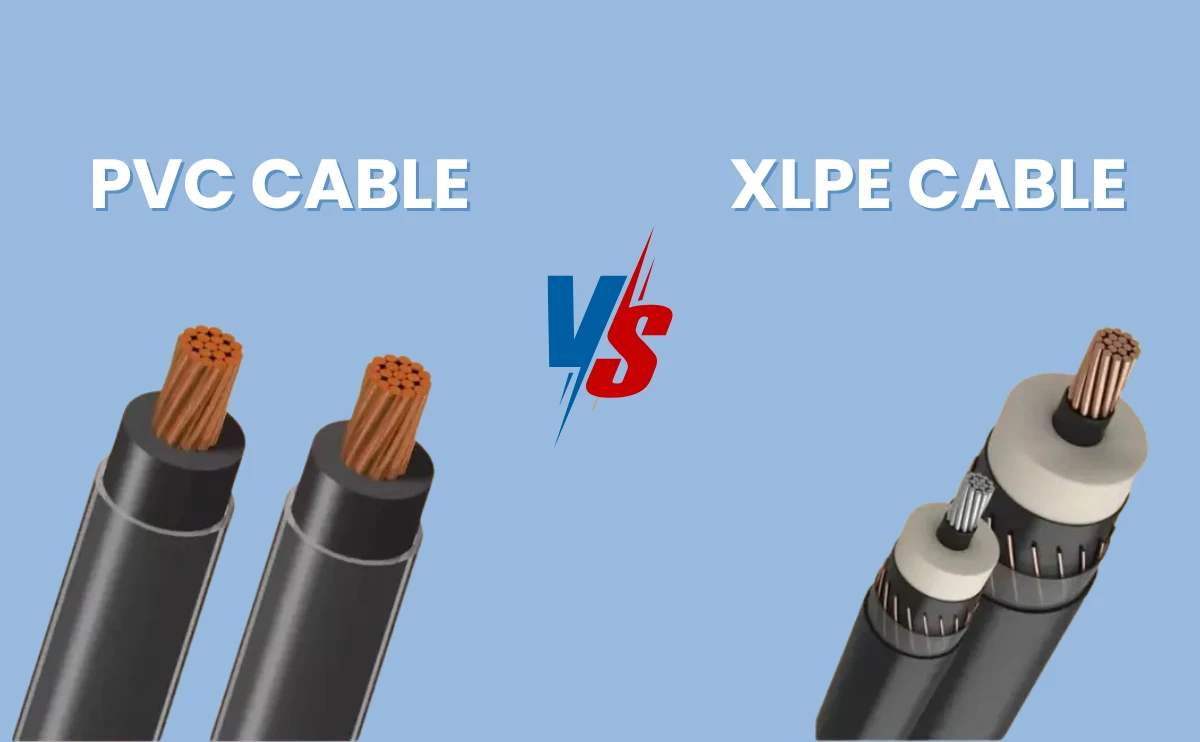
XLPE vs PVC
- XLPE (Cross-Linked Polyethylene) offers higher heat resistance, better mechanical strength, and longer lifespan—ideal for heavy-load, outdoor, or industrial systems.
- PVC (Polyvinyl Chloride) is cost-effective, easy to install, and suitable for standard indoor wiring where heat and UV exposure are low.
Copper vs Aluminum Conductors
- Copper provides excellent conductivity, stability, and reliability, making it preferred for residential, commercial, and critical installations.
- Aluminum is lighter and more economical for large power distribution lines, though it requires larger cable sizes to match copper’s performance.
LSHF vs PVC Sheathing
- LSHF (Low Smoke Halogen Free) produces minimal smoke and no toxic gases during fire—recommended for airports, hospitals, tunnels, and enclosed public areas.
- PVC sheathing is acceptable for general environments without strict fire-safety requirements and remains budget-friendly.
Selection Factor 4: Armouring & Protection
- When Armouring Is Needed (STA / SWA)
Armoured cables—STA (Steel Tape Armour) and SWA (Steel Wire Armour)—are essential when cables face mechanical stress, heavy impact, or underground installation. STA is common for fixed indoor/underground routes, while SWA is better for outdoor or high-tension environments.
- Protection Against Rodents
In regions with rodent activity (common in Southeast Asia, India, and rural construction sites), armouring or corrugated steel/aluminum sheaths helps prevent gnawing damage and service failures.
- Protection Against Corrosion & Moisture
In coastal, humid, or chemical-exposed environments, choose cables with:
Galvanized steel armour for corrosion resistance
PVC/XLPE outer sheaths for moisture blocking
Water-blocking layers for underground or flood-prone zones.
Selection Factor 5: Cable Structure
Bend Radius
Different cable constructions allow different bending limits. A smaller bend radius is essential for tight installations such as panels, conduits, and compact machinery.
Flexibility Level
Flexibility depends on sheath material, insulation, and conductor class. Flexible cables reduce installation difficulty and prevent stress damage during movement or vibration.
Conductor Class
Conductor classes (Class 1, 2, 5, 6) determine how rigid or flexible a cable is:
Class 1: Solid conductor — rigid, for fixed wiring
Class 2: Stranded conductor — semi-flexible, general power supply
Class 5/6: Fine-stranded — high flexibility for machinery and mobile equipment
Comparison Table: Bend Radius, Flexibility, Conductor Class
| Feature | Class 1 (Solid) | Class 2 (Stranded) | Class 5/6 (Flexible) |
|---|---|---|---|
| Bend Radius | Large (least flexible) | Medium | Small (easy to bend) |
| Flexibility Level | Low | Medium | High |
| Best For | Building wiring, fixed installation | Power distribution, control cables | Robotics, equipment, tight spaces |
Choose the Right Cable With NAN CABLE
Selecting the right electrical cable comes down to understanding your market’s standards, environment, materials, and protection needs. With over 40 years of manufacturing experience, NAN CABLE has supported mega projects across Asia, Africa, and Australia, backed by a professional engineering team that ensures every cable meets strict global requirements.
If you need guidance for your specific region or project, our team can help you make the safest and most cost-effective choice.
Continue learning:
Read our next guide: “How to Choose Electrical Cables for International Projects (5 Cable Types + 3 Region Comparison)”